Skip to content
The MerchantQuality is an intelligent effort
The Merchant · A study of the recordMonograph 04 / Origin, labour and the quill
← Return to Ceylon Cinnamon

A history read without romance

Ceylon Cinnamon:
Origin, Labour and the Quill.

The record is one of valued bark, concealed origin, commercial power and exceptional Sri Lankan skill. It deserves precision rather than mythology.

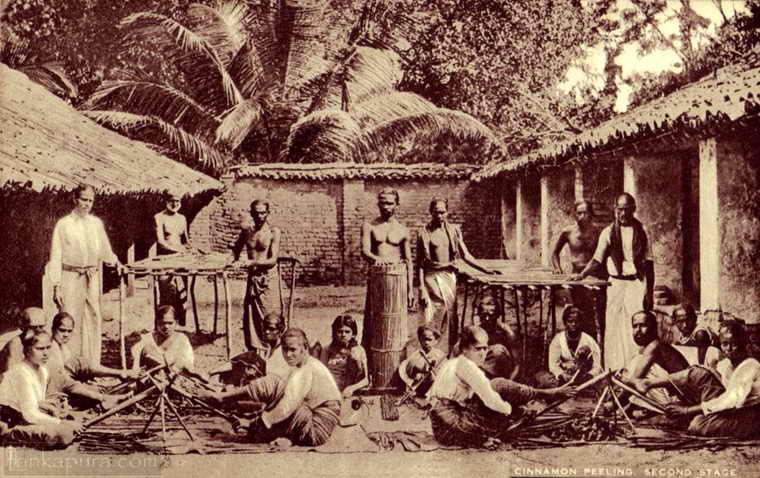
A historical photograph of Sri Lankan cinnamon workers peeling and preparing cinnamon in a village courtyard
Historical recordCinnamon peeling, second stage · source page: Sri Lanka Export Development Board ↗

Before the chronology

An old name
is not always a species.

Words translated as “cinnamon” and “cassia” occur in ancient accounts of fragrance, ritual, food and medicine. Yet early names were applied to more than one aromatic material. The botanical identity behind a particular passage may be uncertain, and it should not be made precise merely because the modern name is familiar. [01]

The distinction matters here. This page concerns Sri Lankan Cinnamomum verum. Ancient esteem provides cultural context; it cannot establish continuous Ceylon provenance, and historical medicinal use is not evidence of modern clinical effect.

A selective chronology

From obscured source
to stated origin.

This is not a procession of discoverers. It is a record of changing knowledge, commercial control and the people whose work made the trade possible.

I

Aromatics beneath a shared name

Ancient and classical texts demonstrate that aromatic substances called cinnamon and cassia were valued and circulated. They do not always allow the modern reader to determine species or place of origin. Even the much-repeated identification of Egyptian “cinnamon wood” is questioned in the specialist botanical literature. [01]

II

Sri Lanka becomes more visible

Accounts differ over the earliest explicit identification. Sri Lanka’s Department of Cinnamon Development points to a late tenth-century reference in Aja’ib al-Hind; the EU geographical-indication record foregrounds a thirteenth-century account. Rather than force a single “first”, both show the source becoming increasingly legible in the medieval record. [02] [03]

III

Trade becomes colonial monopoly

Portuguese power on the coast reorganised the cinnamon trade around compulsory supply and monopoly. Official Sri Lankan accounts describe pressure upon rulers, producers and forests as demand intensified. The value was created locally—in bark gathered, prepared and peeled—while control over its movement was claimed elsewhere. [06]

IV

Dutch control, obligation and resistance

After the Portuguese were displaced from the maritime territories, the Dutch East India Company controlled the coastal cinnamon trade. Production relied upon systems of obligatory labour. Archival research records repeated resistance, including revolts among cinnamon peelers during the eighteenth century. Commercial order was neither neutral nor freely given. [04] [06]

V

Expansion under British rule

Britain took the former Dutch coastal possessions in 1796 and later ruled the whole island. Export policy changed, plantation acreage expanded and cinnamon cultivation travelled to other tropical regions. Sri Lanka nevertheless remained the place most closely associated with the fine, layered quill and the reputation carried by the name Ceylon Cinnamon. [01] [02]

VI

Origin stated, protected and examined

After independence, Sri Lankan institutions developed research, training and industry support around cultivation, quality and processing. In 2022 the European Union registered “Ceylon Cinnamon” as a protected geographical indication, formally connecting the designation with Sri Lankan origin, knowledge and reputation. [02] [03]

The people in the record

No history of cinnamon
without the peelers.

A surviving drawing made in Sri Lanka in 1662 depicts two Salagama cinnamon peelers at work with branches and peeling knives. It is a quiet corrective to histories told only through merchants, governors and companies: the commodity began with skilled hands. [05]

Under Dutch rule, this knowledge was drawn into a system of corvée labour. Communities were obliged to harvest and deliver cinnamon; petitions and recurrent revolts testify to the burden. To acknowledge skill without acknowledging coercion would turn workmanship into decoration. [04]

Examine the 1662 record at the Rijksmuseum ↗

The enduring form

The quill was made
to travel.

Peeled inner bark was traditionally fitted together and rolled into quills to make a delicate material easier to dry, keep and transport. Field research describes quill-making as the most labour-intensive part of production: bark is loosened, nested, extended with carefully fitted pieces and dried indoors. [01] [07]

The form is more than appearance. It records an accommodation between the material and the hand—fine bark made stable through construction. Today’s grades describe that finished architecture with greater precision; they should not be projected backwards as though Alba and C5 were ancient names.

Examine AlbaExamine C5

The present claim

Heritage is not
a substitute for proof.

The Merchant does not claim descent from the monopolies that once obscured origin. The useful inheritance is different: a named species, a Sri Lankan geographical identity, a demanding craft and a record that can be examined rather than embellished.

That is also why provenance belongs in the present tense. Historical reputation may explain why Ceylon Cinnamon is valued; authentication must connect a contemporary statement with a contemporary product.

Explore Serendib Authenticate →

Sources and method

The record
behind the account.

Return to the ingredient

A history made material.
A quill made by hand.

Continue to the principal monograph for species, grade, culinary character and the House selections.

Explore Ceylon Cinnamon